
On Communication
… and building our shared realities

You have probably never heard of W. Timothy Gallwey, but he is considered by many to be the father of coaching, so the next time someone tries to sell you a course for a pretty penny claiming they are “a coach”, you know who to thank.
To be frank, I quite liked his 1974 bestseller The Inner Game of Tennis, in which he argues tennis players - and all of us, ultimately - are always playing two different games: a mental one first and foremost, and an external one, which can be tennis, golf, music or anything really, which is secondary.
I believe this is very much aligned with what we have already discussed previously on how our thoughts form our internal realities, but that is not why I am interested in discussing Gallwey.
What caught my attention in The Inner Game of Tennis was how Gallwey came to his realisation. After a stint as a tennis player, Timothy Gallwey became a tennis coach at Harvard University. As the story goes, one afternoon, coach Gallwey tried out a different approach to teach a novice student, Paul.
Instead of telling Paul what he should do, coach Gallwey simply picked up a few balls and hit a few forehands. He then told Paul to do the same. It stunned Gallwey to realise Paul did a much better job than most of his other students.
In Gallwey’s words:
I was beginning to learn what all good pros and students of tennis must learn: that images are better than words, showing better than telling, too much instruction worse than none, and that conscious trying often produces negative results.
Yes, a picture is worth a thousand words, but there is more to unpack from this.
A Model for Communication
Gallwey and his pupil were communicating, which essentially means they were exchanging information. There is an interesting concept I recall from my time in Engineering school called entropy in information theory.
Coined by Claude Shannon, the father of information theory, entropy measures the level of “information” or “surprise” of a given message. Shannon’s goal was to mathemathise communication, but I want to focus on the building blocks he used, not the equations.
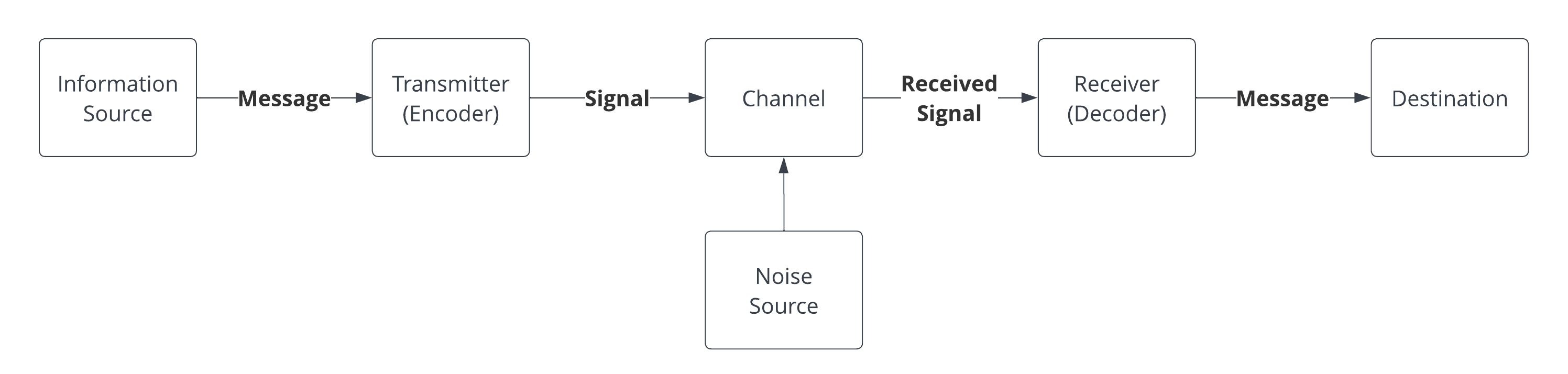
Let us use Gallwey’s interaction with Paul to illustrate Shannon’s model of communication. According to it, communication involves a few elements:
The Sender, or the source of information, Gallwey in this case
Who encodes his Message - tennis instructions - using words and gestures
This message is transmitted as a Signal: voice and/or images
Through a Channel which in this case is air
External Noise affects the quality of the message received
Paul, the Receiver on the other end, decodes the images and words he receives and interprets Gallwey’s message
But there is another thing happening when it comes to Gallwey’s interaction with Paul. Gallwey realises non-verbal communication is more effective to get his point across because there is less encoding and decoding involved when he is not using words.
Verbal vs. Non-Verbal Communication
The explanation for this lies in our physiology. Different parts of the brain deal with verbal and non-verbal communication.
Our limbic brain, the emotional side of our brain, processes non-verbal communication, whereas the neocortex, our thinking brain, is responsible for verbal communication. Naturally, both parts of the brain might be used to interpret both verbal and non-verbal communication, but it goes to show that as a whole, the brain deals differently with these two stimuli.
Moreover, this shows a clear trade-off that happens when we opt for one form of communication instead of the other. Non-verbal communication is more direct, faster and involves less rationalisation, but when too much rationalisation is not necessary, or even wanted, as in Gallwey’s case, it makes sense.
Verbal communication, on the other hand, allows us to discuss higher-level ideas, but it also means we have more sources of noise given that words, the very entities that allow those abstractions are prone to noise themselves.
Words are, ultimately, symbols and, to quote from Aldous Huxley’s The Doors of Perception, “however expressive, symbols can never be the things they stand for”. Quite literally, a word is a symbol used to represent an object but a symbol will never be the object itself, an idea logician Charles Sanders Peirce posited in his triadic model.
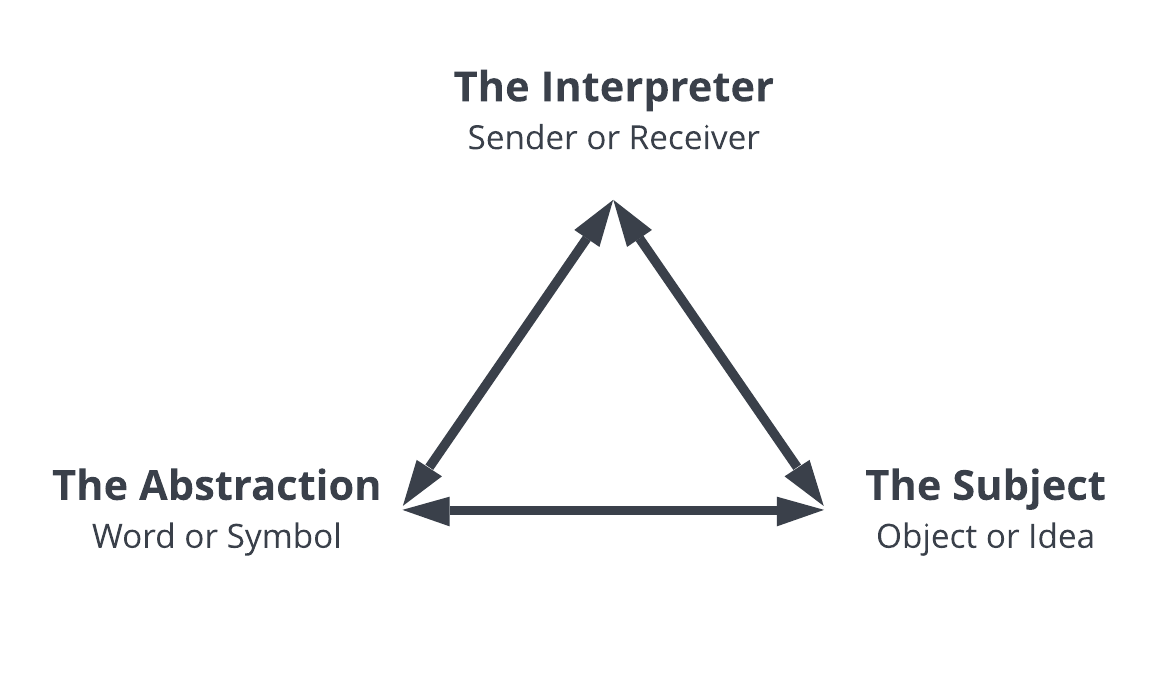
There is what the Subject is, what the Interpreter understands from that and what the chosen Abstraction - word or symbol - can effectively encapsulate from the Subject and the Interpreter's understanding. There is “noise”, or imprecision, on both the sender and the receiver’s side. In fact, “noise” that is not even known to the sender or the receiver.
Words and their Limits
Austrian linguist Ludwig Wittgenstein famously said “the limits of my language means the limits of my world”. I would argue we are barely aware of the influence language has on our behaviour or the consequences a limited vocabulary has on our ability to experience the world.
We use words to describe our experiences and express our thoughts, so it is hard to evaluate the extent to which our toolbox - i.e. our lexicon - might be limited.
It would be like trying to assess our miopia using our own eyes.
To quote Saramago, “one needs to leave the island in order to see the island”, meaning we need to learn other languages, with different abstractions and structures, to find gaps in our mother tongues.
In fact, rephrasing our thoughts in another language foces us to boil them down to their essence, an enlightening process in itself.
There is a fantastic TED talk by behavioural economist Kevin Chen in which he illustrates how languages unbeknowingly affect speakers’ attitudes.
Controlling for other variables, Chen argues that speakers of futureless languages - languages in which there is not a clear difference between the present and the future, such as Finnish, German or Japanese - perceive the future as something closer to the present which, in turn, conditions their actions to be more prudent. Futureless language speakers are 30% more likely to save money, 20% less likely to smoke and 21% more prone to using condoms.
On the other hand, speakers of futured languages - those in which there is a stronger distinction between the present and the future - perceive the future as something separate, distant. Consequently, speakers of futured languages such as English, Greek or Italian downplay the importance of preparing themselves for the future and act in a more reckless way.
This links perfectly with Peirce’s triadic model: in futured languages, the gap between the object, “the Future”, and the speaker is wider than in futureless languages. The feeling that “the Future” is something distant alienates the speaker and conditions his actions to downplay the Future’s importance.
Chen’s hypothesis hints at a wider theory, the Sapir-Whorf theory of Linguistic Relativity, which argues that people’s perceptions are conditioned by their spoken language.
Chen, who also speaks Mandarin, mentions how English speakers can encapsulate a simple relationship between a son and his father’s brother using the word “uncle”. In Mandarin, describing the same relationship requires a lot more information - knowing for instance whether the brother was older or younger than the father’s son or if he was his brother or brother-in-law - changes the words used to describe the relationship.
Though I do not speak Mandarin, I had noticed something similar in Italian, which has one word “nipote” to describe both “nephew” and “grandson”, providing even less information to the listener. Could this help explain how different cultures understand and deal with familial relationships? Potentially.
Other interesting examples of Linguistic Relativity relate to space and time. Whorf argued different languages encoded spatial and temporal perceptions in different ways.
I believe this shows why translating is not an exact science and why there are so many misunderstandings between people speaking different languages: our languages condidtion us to interpret the world in very different ways. As can be seen in the illustration below, there is no word to directly translate “around” in either Mandarin or Chichewa, a language spoken in Malawi.

Although Linguistic Relativity as a theory has faced much contention over the years, I would argue it illustrates how languages, thoughts and behaviours, much like we saw with Cognitive Behavioural Therapy, shape one another.
Changing Meanings
Effective communication boils down to common ground. For interactions to take place, there needs to be a common means of communication, a shared language and concepts that are agreed upon by all parties involved.
Different intepretations for the same concepts may impair or even prevent communication altogether. In turn, changing how people perceive a certain concept, or how one interprets a given word may lead to introjection: the unconscious adoption of ideas and attitudes.
George Orwell famously explored this phenomenon in 1984. In the novel, Newspeak is a simplified version of the English language created by the ruling party to curb individuals’ ability to think and articulate subversive thoughts.
Interestingly, Orwell’s fictional Newspeak may not have been so fictional.
Many of the contractions found in Newspeak such as “Ingsoc”, English Socialism, or “Minitrue”, Ministry of Truth, are similar to words adopted during the Nazi regime or in the Soviet Union. In fact, the word “Nazi” itself is a contraction of Nationalsozialist, or National Socialist.
Peirce explains why: acronyms distance the Abstraction from the Subject, alienating the Interpreter.
Citing George Orwell and 1984 has become cliché, but I believe we fail to see how Orwellian our world has become. A perfect illustration of how subtly altering meanings of words alters behaviours comes from another George, George Carlin.
Carlin masterfully illustrates how euphemisms sterilise and de-personalise words, distancing their meaning from speakers, just like Chen argues for futured languages. Carlin’s “soft words” make it harder to transmit a sense of urgency or importance when communicating, just like George Orwell illustrates in 1984.
In his Intellectuals and Society, economist Thomas Sowell calls this “verbal cleansing”, and remarks that “newly coined words for old things appear in many contexts, often erasing what experience has taught us about those things”.
Carlin, Orwell and Sowell all echo the same warning: when we refer to “bums” as “homeless”, to “criminals” as “victims of society”, to “prostitutes” as “sex workers”, we alienate ourselves and, unsurprisingly, do not devote the amount of attention many of these questions demand.
Lost and Isolated
1984 was published in 1949 and Carlin’s excerpt dates from 1990, over 30 years ago today. Today, Carlin’s “soft words” have been renamed “political correctness” and we have come up with concepts such as safe spaces that further incentivise people not to talk at the risk of offending others.
Even worse, fallacious notions such as standpoint theory curb our human instinct for empathising with one another, something we desperately need.
Published in 2018, Jonathan Haidt and Greg Lukianoff’s The Coddling of the American Mind discusses at length how universities, the de facto environment for discussions and the advancement of knowledge, are stifling free speech and increasing polarisation by putting emotional safety above all else.
It is worth noting that criticism towards woke culture, safe spaces and standpoint theory stem from both sides of the political spectrum. Stephen Fry is another example of a liberal who has voiced his concerns about safe spaces and how they are infantilising behaviours and curtailing students’ capacity to think, articulate and argue with one another.
My aim is not to turn this into a political argument, but to illustrate how antagonic these concepts are to intelligent discussions and a subsequent reaching of an understanding.
Softening words to protect emotions is distancing us from conversations, and furthering polarisation. Today, we face the challenge of building bridges and reaching understanding and for that we need to communicate in the first place.
Like Gallwey, we could simplify what we are trying to express, dumb-down our interactions to simple ideas that can be mimicked or stuck into short videos (sounds familiar?) and cut the neocortex out of the equation. Realistically, however, higher-level communication is necessary to curb extremisms, find understanding and form a social fabric and a shared reality.
As a society, we could use a coach for that.
If you have read this far, firstly, a big thank you. If these thoughts made you stop and ponder, I have achieved my goal! Subscribe below for future posts!